AI in Construction: How to Search Years of Project Documents in Seconds
Learn how construction and engineering teams can search specifications, contracts, RFIs and project archives with AI while keeping source documents and permissions in control.
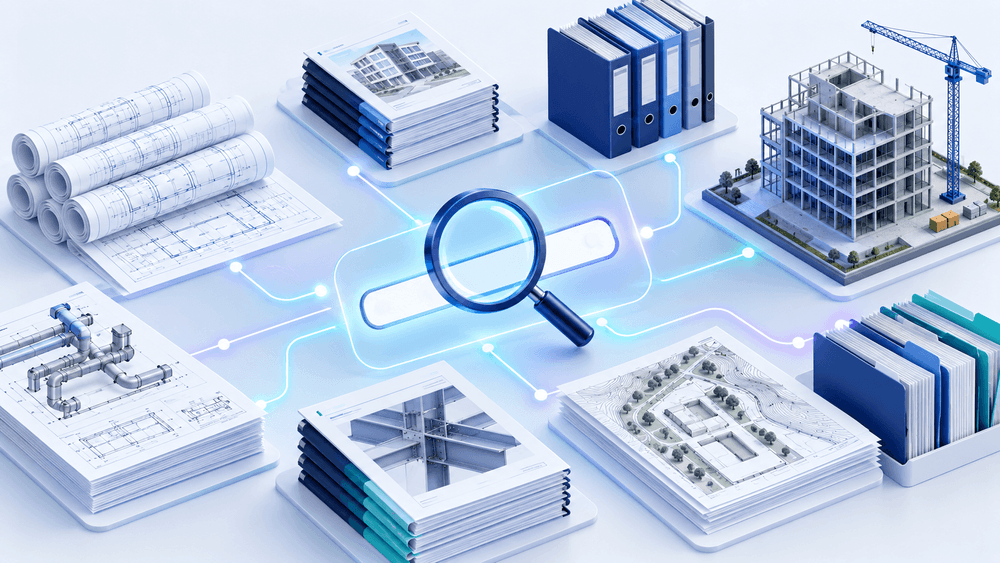
Construction projects produce a large amount of useful information. Contracts, specifications, bills of quantities (BOQs), requests for information (RFIs), meeting minutes, reports, tenders and correspondence all record decisions that a team may need again. The difficulty is that these records often sit in different systems, under different project names and folder structures.
When a new project starts, an engineer may remember that a similar detail was solved years earlier but not know which archive contains it. A commercial manager may need an example of a particular contract clause. A tender team may want to find previous specifications without opening hundreds of files. In each case, the knowledge exists, but retrieving it takes too much time.
AI in construction can help with this very practical problem. A search system connected to authorised project documents can let people ask normal questions, find relevant passages and open the original sources. It can make existing information more useful while the company keeps its document control process and project systems.
Construction Has a Retrieval Problem
Most construction companies do not need to create more documents before they can benefit from AI. They already have years of project records. The challenge is knowing where the right information is and whether it is the current, approved version.
Traditional folder search works well when a person knows the project, document number or exact phrase. It becomes less helpful when the question is broader. Someone may remember a waterproofing solution but not the name used in the file. Another person may search for “delay notice” while the document uses different contractual wording.
The problem grows when teams use several repositories. A project may have an official document platform, shared drives, email attachments and locally saved working files. If there is no clear way to search across the authorised sources, people rely on colleagues who remember where things are. That slows down work and makes valuable knowledge dependent on a few individuals.
What an AI Project Knowledge Base Could Do
Imagine an engineer asking: “Find completed projects where we used this waterproofing specification, and show the relevant requirements.” A useful system would search the project archives the engineer is allowed to access, identify likely documents, extract the relevant sections and provide a short answer with links to the original files.
The source links matter as much as the answer. The engineer must be able to check the specification, its project context, date and revision before using it. An AI summary can point someone to information quickly, but it should not become the authority for a technical or contractual decision.
This type of system is an AI knowledge base built from company documents, applied to construction information. It connects search and question answering to the company's own records rather than asking a general AI model to guess what happened on a past project.
Which Construction Documents Can Be Searched?
The first candidates are usually text-heavy files: contracts, specifications, BOQs, tender documents, method statements, RFIs, submittals, meeting minutes, inspection reports, project correspondence and lessons learned. These documents contain language that can be indexed and linked back to a project, discipline, date and version.
Scanned PDFs may also be useful, but they need reliable text extraction. A poor scan, handwritten note or complex table can produce incomplete text. BOQs and schedules need particular care because a row can lose its meaning if quantities, units and descriptions are separated during processing.
Drawings and models require a different approach. If the question concerns a drawing title, revision, annotation or sheet reference, associated text and metadata may be enough. Understanding geometry, details or relationships inside a drawing or BIM model is a more specialised task. It should be tested separately rather than assumed to work because a system can search PDFs.
Practical Uses for Project Teams
Find comparable project work. A project team can search previous specifications, technical submissions or method statements to see how a similar requirement was handled. The result is a starting point for professional review, not a template to copy without checking the new project's conditions.
Locate contractual and technical requirements. A user can ask where a contract defines a notice period, or which specification section describes a material requirement. The system should return the precise passage and document reference so the user can read the full clause in context.
Search decisions and correspondence. Meeting minutes, RFIs and correspondence often explain why a decision was made. Search across these records can help a team trace the issue, response and later change instead of reading a long sequence of files manually.
Support tenders and preconstruction. Tender teams can find relevant experience, common qualification points or earlier technical solutions. They still need to verify that information is appropriate for the current client and tender requirements.
Help new team members learn a project. A new project manager or engineer may need to understand the history of a package quickly. A searchable knowledge base can surface key documents and decisions, while the official project record remains the source of truth.
Why Search Quality Depends on Project Context
An AI search system cannot treat every similar sentence as equally useful. In construction, a passage from a superseded drawing or an unrelated project may look relevant but lead to a wrong conclusion. Good retrieval therefore depends on context such as project, client, discipline, document type, revision, status and issue date.
For example, “find the latest approved fire door specification for Project A” is different from “show examples of fire door specifications used on past hotel projects.” The first question needs strict filtering by project and approval status. The second is a research task where several historical examples may be appropriate.
Duplicates also matter. The same PDF may appear in a document platform, a shared drive and an email attachment. Without version and source rules, a system may show several copies or favour an old one. Before building AI search, a company should decide which repository is authoritative for each type of document.
Permissions Must Follow the Documents
Construction companies often work with several clients, joint ventures, consultants and subcontractors. Access to one project does not mean access to every project. Commercial files, bid information and contractual correspondence may also have more restricted audiences than general technical documents.
The AI layer should respect those boundaries. A user should only retrieve passages from documents they are authorised to see, and source links should open through the existing access controls. This needs to be part of the search design from the beginning, not a filter applied after confidential text has already been sent to a model.
Permissions are especially important when old project archives are combined into one search experience. A single search box can be convenient, but the underlying results still need to follow the rights attached to each source.
Document Control Still Matters
AI search can improve access to information, but it cannot decide on its own which drawing is approved for construction or whether a contractual notice is valid. Those questions depend on formal workflows, project roles and the complete record.
A responsible system should display document status and version when available, identify the source of each answer and make uncertainty visible. If the documents do not contain enough evidence, it should say so. The right next step may be to open the original file or ask the document controller, engineer or contract manager.
The aim is to reduce the time spent locating information. It is not to remove the review and approval steps that protect project quality and accountability.
Start With One Repository and Clear Questions
A construction company does not need to connect every project system at once. A good pilot may use a completed project archive, a tender library or a controlled set of technical specifications. Completed projects can be a useful starting point because their documents change less often and the team can check search results against known records.
Choose a defined user group and collect real questions they currently struggle to answer. Examples might include finding a specification used on a similar project, locating an RFI response, or identifying the latest approved method statement for a work package. Then test whether the system retrieves the right source, shows the correct version and avoids unauthorised material.
Success should be measured by the usefulness of the retrieved documents and the time saved in finding them, not by how fluent the AI answer sounds. If the pilot works, the company can connect more repositories and support additional teams.
Make Existing Project Knowledge Easier to Use
Construction AI is often discussed in terms of design automation or future site technology. For many companies, a nearer opportunity is to make the documents they already have easier to find and reuse.
Years of specifications, contracts, RFIs, reports and project decisions can support better work on the next project, provided employees can find the right record and verify it. A well-designed AI knowledge base can give teams a practical search layer across authorised information while preserving document control, permissions and source references.
If your construction or engineering team has years of project documentation that is difficult to reuse, Codativity can help assess whether it is suitable for an AI knowledge system and identify a focused first use case.

23/9/2026
Contact Us

701, Opal Tower Business Bay, Dubai United Arab Emirates
P.O.Box 126732

Let's Work Together
© 2016 - 2026 Codativity Software Solutions. All Rights Reserved.